
Masonry Repairs That Hold Past the First Season
Chimney Repairs in Hillsborough for crown failure, deteriorating mortar joints, broken tiles, and flashing leaks that require actual masonry work
Chimney repair done by someone without masonry training often means patching over a structural problem with caulk or hydraulic cement—materials that look complete at the end of the day and fail before the following year. Soot Solutions Chimney in Hillsborough approaches chimney repairs differently because the business is mason-owned and operated, not simply a cleaning service that patches as a side job. When a crown is cracked, it is rebuilt or properly repointed. When clay tiles are damaged or undersized for the liner configuration, they are broken out and the interior is rebuilt. The repair holds because the material and method match what the structure actually requires.
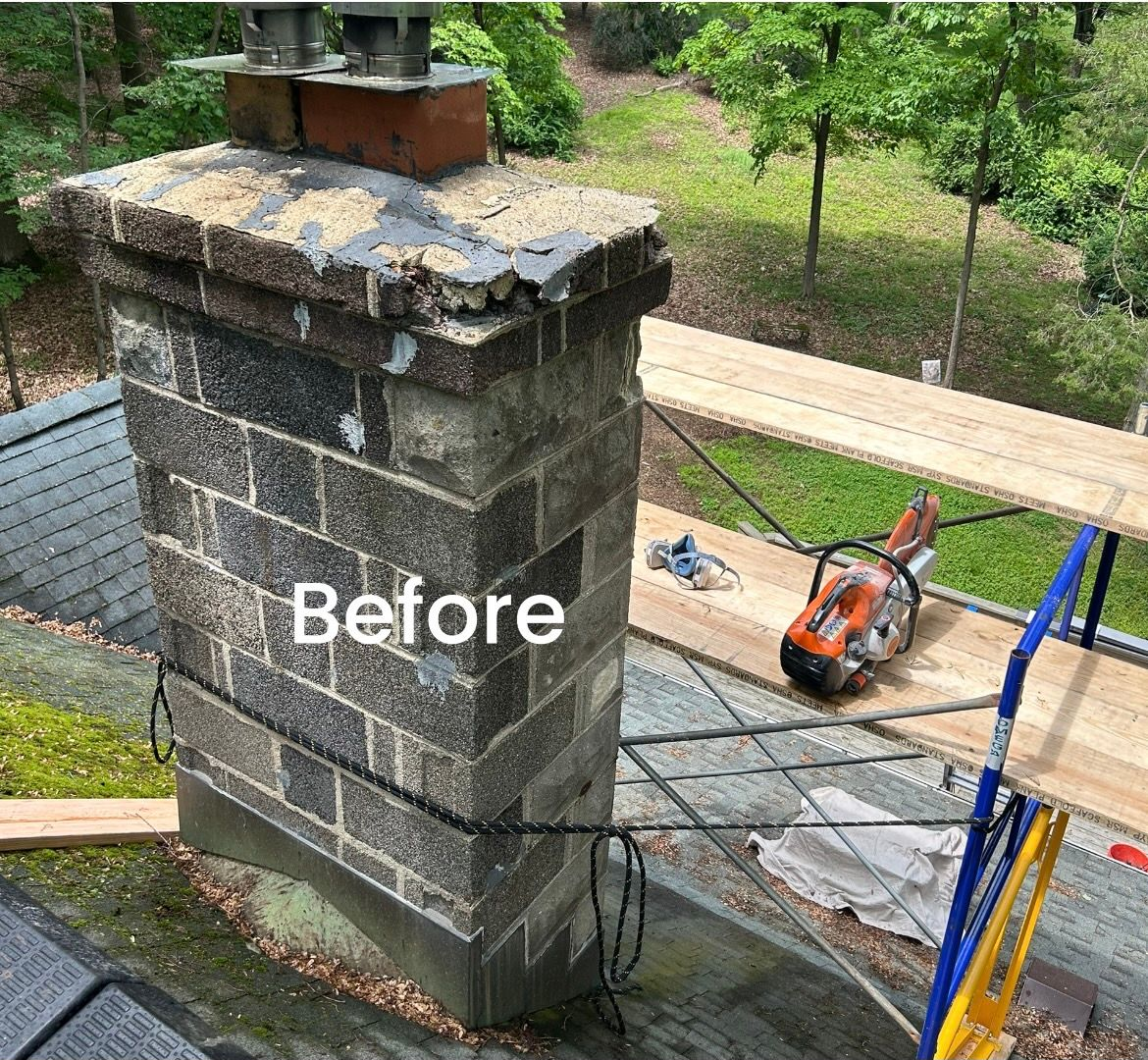
The process begins with damage assessment—determining whether the problem is crown failure, deteriorated mortar joints, broken or displaced tiles, or a flashing leak at the chimney base. Each failure mode calls for a different repair sequence. Mortar repointing requires removing the failed material to a sound depth before new mortar is packed, not simply spreading fresh mortar over the old face. Crown repair or rebuilding uses mortar formulated for exposed masonry at the chimney top, where thermal expansion and contraction are most severe. Flashing repair addresses how the metal integrates with the brick rather than layering sealant over a gap that will reopen.
Have Soot Solutions Chimney assess your chimney's damage to get a clear repair recommendation based on what the structure actually needs.
How Chimney Repair Is Done Correctly
The distinction between cosmetic patching and structural repair is visible in how the failed material is treated before anything new is applied. On a tuckpointing job done correctly, deteriorated mortar is cut or raked out to a minimum depth of three-quarters of an inch before new mortar is packed—this gives the fresh material enough mass to bond properly and resist loading. A patch applied over soft or crumbling mortar without that preparation looks the same on the day it is done and fails at the first stress cycle because there is no sound substrate beneath it. Soot Solutions Chimney performs mortar work to the depth the joint requires, not to the depth that is fastest.
After structural repairs are completed, what you notice is the absence of the failure signs: water that was tracking inside the firebox stops, draft problems caused by displaced tiles resolve, and the crown no longer shows active cracking or spalling at the edges. The chimney exterior no longer shows the open horizontal mortar lines that signal water is finding its way into the masonry stack.
Somerset and Piscataway-area chimney stock includes a significant number of structures built in the 1950s through 1970s with mortar formulations that have exceeded their service life—these joints look intact from a distance but are soft enough to be scraped out with a key, which means water infiltration has been happening for years before a homeowner notices interior damage. That pattern makes assessment before repair critical: the visible deterioration often understates how far the failed mortar extends into the joint.
What Homeowners Ask About Chimney Repair Work
The questions below address how chimney repairs are assessed and performed, what the difference between structural and cosmetic work involves, and what you can expect once repairs are complete.
How is the scope of a chimney repair determined before work begins?
The assessment identifies which components are failing—crown, mortar joints, tile liner, or flashing—and how far the damage extends, because surface cracking in a crown, for example, can indicate either minor repointing or full crown replacement depending on whether the structural layer beneath is sound.
What does proper mortar repointing involve compared to surface patching?
Correct repointing requires removing deteriorated mortar to a minimum depth before new material is packed into the joint; surface patching without that preparation bonds to compromised material and typically fails within one to two heating cycles when the joint expands and contracts.
When do damaged clay tiles require removal and replacement rather than repair?
Tiles that have shifted out of alignment, separated from the mortar bed, or cracked through their full thickness cannot be patched in place—they must be broken out and the section rebuilt, because a hairline-repaired tile that has already moved once will continue to move and open gaps at the joint above or below it.
How does the construction era of chimneys in the Somerset and Hillsborough area affect what repairs are needed?
Chimneys built between the 1950s and 1970s used mortar mixes with lime content ratios that have largely carbonated and softened over decades; those joints often appear solid from the exterior but have lost structural integrity, making repointing more extensive than it looks from the ground.
What does a completed chimney repair look like from the exterior, and how do you verify the work held?
Properly repointed joints are flush with the brick face, uniform in color and texture, and free of surface cracking at the new mortar interface; rebuilt crowns show no open joints at the flue tile surround or at the drip edge, and the transition between the crown and chimney sides is sealed without visible gaps.
Soot Solutions Chimney also performs chimney repairs in Bridgewater, Somerset, Princeton, North Plainfield, and Manville. To have your chimney assessed and get a repair plan based on actual structural findings, call Soot Solutions Chimney at (732) 688-7484.